For those that have seen me speak around the world, you will recall my passion for sharing innovative videos that with few or no words convey powerful messages.
The days of busy PowerPoint charts are over. For my entire career, the mantra has been "less words, more graphics". In a world where our attention span is down to 8 seconds, even 140 or less Twitter characters are too much to actually read.
Video is the new medium required to package successful branding. The following are my current favorite future predicting retail technology videos.
NRF 2017 opened on good news that USA 2016 retail holiday sales increased 4% over the previous year to $658.3 billion, exceeding initial National Retail Federation forecasts. Number includes $122.9 billion in non-store sales which were up 12.6%.
For the106th Annual Convention & EXPO in New York this past week, NRF forecasted 35,000 attendees. The 2017 edition will exceed the over 3000 retail companies from over 90 countries attending the previous year.
On both personal and professional levels this was one of the best NRF events ever. Always enjoy participating in the motivational and educational RetailROI event on Saturday. During NRF, the group raised over $500,000 in support of global Retail Orphan Initiatives.
The past couple of weeks were filled with the delivery of regionally customized presentations on the future of retail in Spain, UK, Portugal, and Switzerland. As we are in the middle of the paramount shopping season, special focus was on three important retail holidays.
Black Becomes Cyber While Overtaken By Singles
Black Friday
Over both Thanksgiving and Black Friday, 2016 brick-and-mortar net instore sales dropped 5% and the number of transactions fell 7.9%. Shopper visits to physical stores declined 1% during the same two day period. UK 2016 Black Friday shopper traffic fell a significant 8% which follows a drop of 4.05% in 2015.
Two weeks ago, had the pleasure of speaking to the Board of Directors at two major Brazil apparel retailers. An updated view on "The Disruptive Future of Retail" was the message. Very pleased that audience was engaged, embracing of the disruptive trends discussed, and had lots of questions on their direct impact in the Brazil retail market.
"We want people to be able to use those (Frequent Flyer) miles not to fly for free but to control your experience." - Glen Hauenstein, Delta Airlines President (March 2016)
American Airlines is credited with the development of the first loyalty program in 1981. "What distinguished the airline program, and made them the most successful marketing program ever, was a winning combination of the psychological and the financial - the lure of travel (quintessentially aspirational) and the return-on-investment value of the awards (because they awarded unsold seats, the real cost to the airline was miniscule)."
Retailers were not far behind in adapting loyalty programs to increase brand value.
Thirty five years later, it's interesting to contrast the evolution and current state of loyalty programs in both the airline and retail industries.
Have been debating for some time the top 3 retail technology inventions of all time. From history, a few of the candidates considered:
Shopping Mall - The first shopping mall was built in Milan between 1865 and 1877. The Galleria is named after the first King of Italy, Vittorio Emanuele II.
Coupons - In 1888, Coca-Cola created the first coupon that could be redeemed for their new beverage.
Loyalty Card - American Airlines is credited with the development of the first loyalty program in 1981.
CCTV - Germany used CCTV systems in the development of V-2 rockets to monitor launches during World War II.
Credit Card - John Biggins, a New York Banker, introduced the "Charge-It" card in 1946.
A favorite annual report is AT Kearney's Global Retail Development Index (GDRI). The 15th annual edition is titled 'Global Retail Expansion at a Crossroads'.
2016 GDRI Emerging Markets Insights
"Retail in developing countries has seen excellent growth. While the developing world population has grown 21% to 6.2 billion, retail sales in those markets have grown more than 350% and now represent more than half of total global retail sales."
China, India, Malaysia, Kazakhstan, and Indonesia are the top five countries in the 2016 GDRI index. Driven by large populations and high growth, four out of the top five countries are in Asia.
Last week, I had the pleasure to attend a two-day Executive technology briefing at Microsoft headquarters in Redmond. A highlight was the retail technology tour where the latest technologies were integrated into a mock multi-store mall. In each of the store formats, lots of digital sensor solutions were feeding a growing computing cloud.
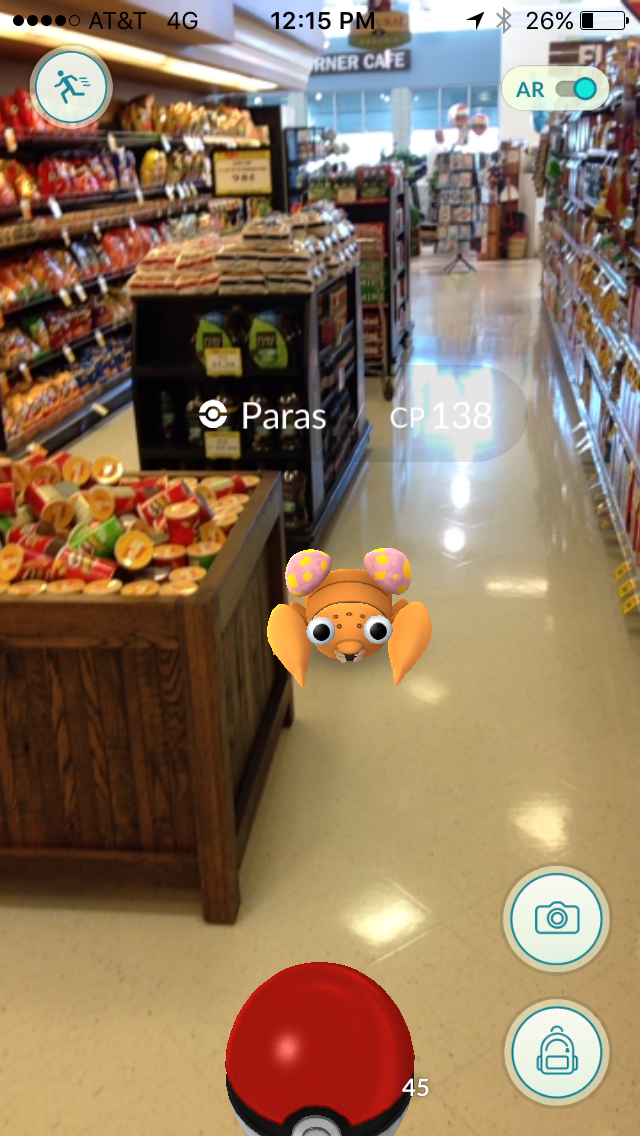
Concurrently to my visit to Microsoft, Pokemon Go continued its meteoric rise in becoming one of the most successful mobile games of all time. As of Monday, July 11th, Pokemon Go was seeing about 21 million daily active users, making it the biggest mobile game in USA history.
Just as impressive is the amount of time that each individual is playing with the app. The average iPhone user spent 33 minutes on the Pokemon Go app, "whereas only 28 minutes on the Facebook app, 18 minutes on Snapchat app, 17 minutes in the Twitter app, and 15 minutes in the Instagram app."
The 2016 USA National Retail Security Survey (NRSS) is jointly conducted by the Dr. Richard Hollinger of the University of Florida and the National Retail Federation (NRF). This year's survey had responses from 80 retailers.
In 2015, the average overall shrink rate was 1.38% of sales which cost the USA retail economy $45.2 billion. For the grocery sector, retail shrink increased from 3.2% to 3.6%. Specialty men's and women's apparel shrink was at 1.2%. Discount, mass merchandise, or super center retailers shrink was at 1.1%.
As the internet is the primary foundation for industry disruption, every year I look forward to Mary Meeker's latest trends report.
Global Internet Growth is Slowing
The internet global population is now at 3 billion. Overall growth is flat at 9% year on year. Excluding India, global internet growth was only 7%. This contrasts to 2009 when the internet was growing at over 15% per year.
India now has 277 million people on the internet, growing at 40% in the last reported year. In 2015, India passed USA to become the number two global user market behind China.
Continuing the journey to learn something new, we explore the Matterhorn in Zermatt Switzerland. Believed to be 50 to 60 million years old, this world-famous mountain was formed when the African crashed into the European tectonic plate.
The Matterhorn, in Italian known as Monte Cervino and French as Mont Cervin, is the 10th highest mountain in Switzerland at 14,692 feet (4,478 meters). The summit was first reached on July 14, 1865 by a team led by Edward Whymper. During the descent, four members of the team fell to their death. The Matterhorn is one of the most dangerous mountains to climb in the Alps with over 500 deaths to date.
The Matterhorn first appeared on the famous Toblerone chocolate in 1960. Look closely at the mountain on the packaging and you will see a bear. This is a reference to the city of Bern, where Theodor Tobler first invented the chocolate bar.
The town of Zermatt at the base of the Matterhorn bans cars to preserve the Alpine environment. The Theodul glacier which you can access from Zermatt is located at 3883 meters (12,740 feet) and offers the highest elevation ski area in Europe.
Being in nature is my go-to motivational escape to clear my mind and prioritize life priorities. Mountains are an amazing inspirational mental canvas because their massive scale makes everything around you, including your worries, feel small. The raw beauty and quiet wilderness provide perspective.
Find your special natural wonder. Enjoy its beauty. Remember that you are here for a short time, and what is around you will live on. Take chances. Setbacks are miniscule, compared to the possibilities of reaching your peak life nirvana. In the lyrics from the Sound of Music, "climb every mountain, ford every stream, follow every rainbow, 'till you find your dream"
Confidence in physical retail remains solid this year. More than 55% of survey respondents said they feel confident or very confident about brick-and-mortar performance in 2026, while only around 20% expressed concern. - From Place AI Read more
The Number 1 country continued lead reinforces a broader trend: countries with strong institutions, high trust, and robust social safety nets consistently rank highest in life satisfaction. - From Visual Capitalist



 NRF 2017 opened on good news that USA 2016 retail holiday sales increased 4% over the previous year to $658.3 billion, exceeding initial National Retail Federation forecasts.



 A favorite annual report is AT Kearney's Global Retail Development Index (GDRI). The 15th annual
  technologies were integrated into a mock multi-store mall. In each of the store formats, lots of digital sensor solutions were feeding a growing computing cloud.