
The retail industry is not immune from all the hype surrounding artificial intelligence. Buzz words abound; Agentic AI, autonomous agents, agentic commerce, autonomous stores, Self-driving supply chains, and even machines that shop on our behalf.
The adoption numbers support the enthusiasm. NVIDIA's third annual State of AI in Retail and CPG survey found 91% of retail and CPG organizations now engaged with AI and 58% actively deploying, up from 42% in 2024. The IBM Institute for Business Value reports that 86% of retail and consumer products executives say AI already delivers a clear, measurable competitive advantage.
Digging deeper into the latest research and acknowledging that retailers are adopting AI at different speeds, there is one key question that I want to answer in this article. What surprises are surfacing to date in the embrace of this disruptive technology?
Here are my top 5 current surprises in the adoption of Artificial Intelligence in the retail industry. I have also included a series of AI charts from the latest edition of the keynote “The AI Disruptive Future of Retail” recently shared in Australia.
Consumers trust the agent and still will not hand over the wallet
Accenture's 2026 Consumer Pulse research, covering 25,590 consumers across 16 countries, found that 74% would trust a personal AI agent more than their best friend to make a purchase. The same study's delegation dial tells a different story about behavior: 74% are ready for task execution, 32% for delegated decision-making, and 9% for fully autonomous purchasing.
Ipsos, surveying 8,500 adults in 15 markets, arrives at nearly the identical number. Among AI-aware consumers, 27% already use AI for product research and only 9% allow AI to make an autonomous purchase. Willingness collapses as price rises. In the US, 22% would let AI buy something under $10, and 8% would let it buy something over $250.
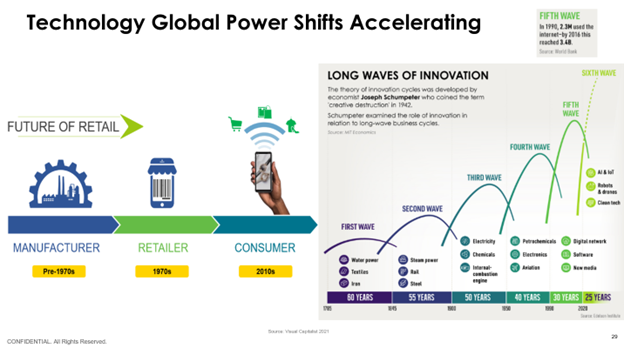
Chart: AI will shift greater retail power to the consumer
My favorite statistic in the Ipsos research is this one. 62% of US consumers want AI brand-constrained, executing on brands and preferences they have already set, against 39% who want AI choosing on its own. Today AI is a preference executor. The preference creator role is still open.
Most of the industry is standing in the shallow end
BCG, working with the Consumer Goods Forum, surveyed 39 senior CPG and retail executives in April 2026. 76% of CPG respondents remain in pilot or exploration mode against only 18% scaling impact. Retail splits into two speeds, with 45% scaling and 40% barely started.
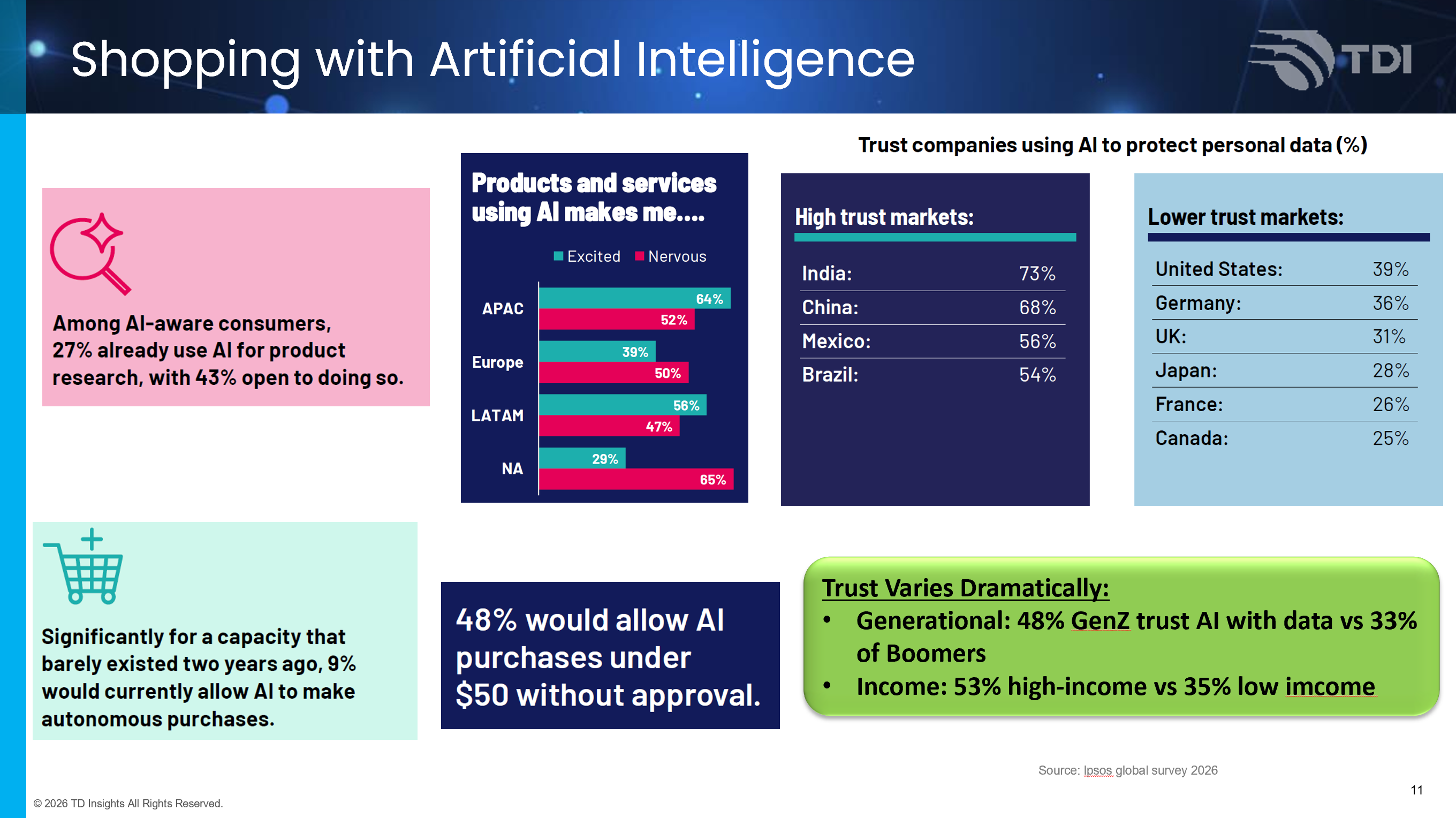
Chart: Greater Trust in AI from Younger Generations
The autonomy picture is starker. 67% of respondents operate in what BCG calls copilot mode, where AI generates the insight and a human decides. Only 9% have reached autopilot, where AI executes inside guardrails. Closing that gap is worth 180 to 360 basis points of cumulative EBIT for retailers. Note that more than half of the companies surveyed do not formally measure ROI on their consumer AI investments at all.
AI creates work before it removes work
Buried in the same BCG research is a number few boards have on a slide. Employees at AI-forward companies spend 52% more time reviewing and correcting AI output, drawn from BCG's AI at Work 2026 study of 11,749 workers. That review burden is real cost, and it lands on the same teams already being asked to move faster.
The bottleneck is data, and the failure mode is worse than being wrong
IBM quantifies the gap precisely. 64% of companies have data accessible to AI, 49% of it is usable, and just 26% is actually used by AI models. IHL Group's 2026 Inventory Distortion Study translates that into operating consequence. Fewer than 25% of retailers have deployed AI and machine learning in the applications most tied to distortion, yet those who have seen 2.3x the sales growth and 2.5x the profit growth of non-deployers.
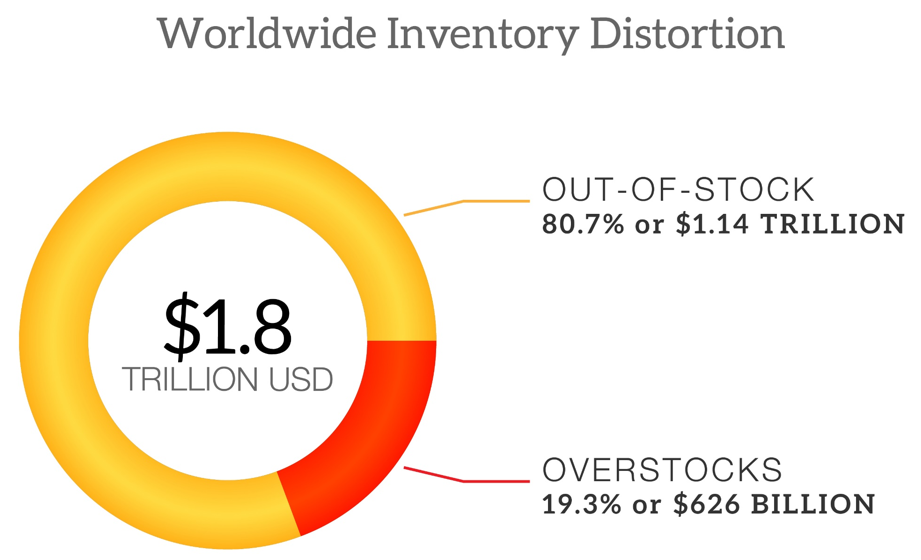
Chart: The Inventory Distortion Global Challenge
IHL's warning about everyone else is the sharpest line in this year's research. Algorithms trained on bad inventory data produce confidently wrong forecasts, acted upon at scale. As agentic systems begin placing replenishment orders inside defined parameters, a data-quality problem stops being a reporting problem and becomes an execution problem running at machine speed.
The differentiator is the executive, not the algorithm
A Dell session at NRF 2026, with panelists from Accenture, NVIDIA and Everseen, put a number on leadership engagement. Executives who invest in understanding AI see 2.5x the ROI of those who delegate the vision entirely. IBM's 2026 CEO Study of 2,000 CEOs across 33 geographies found Chief AI Officer adoption nearly tripled in a single year, from 26% to 76% of organizations. The same study found that only 25% of the workforce uses AI regularly on the job even though 86% of CEOs believe employees have the skills. IBM calls that an organizational design failure rather than a skills gap.
Two field examples land the point. Dollar Tree's directive to do something with AI produced a chatbot nobody used when it mattered. The fix came from leadership narrowing the problem to a custom model that tells district managers which stores need attention each day. And Amazon shows what successful scaling looks like. Their Just Walk Out technology is live in more than 360 third-party locations across five countries, with 150 new stores opening in 2025 alone. The platform continues to evolve with multiple technology options, including computer vision and RFID-based technology. The portable RFID lanes are newer formats for clothing and merchandise at events and pop-ups. The lesson is that lasting impact comes not from showcasing innovation, but from evolving it and operationalizing it at scale.
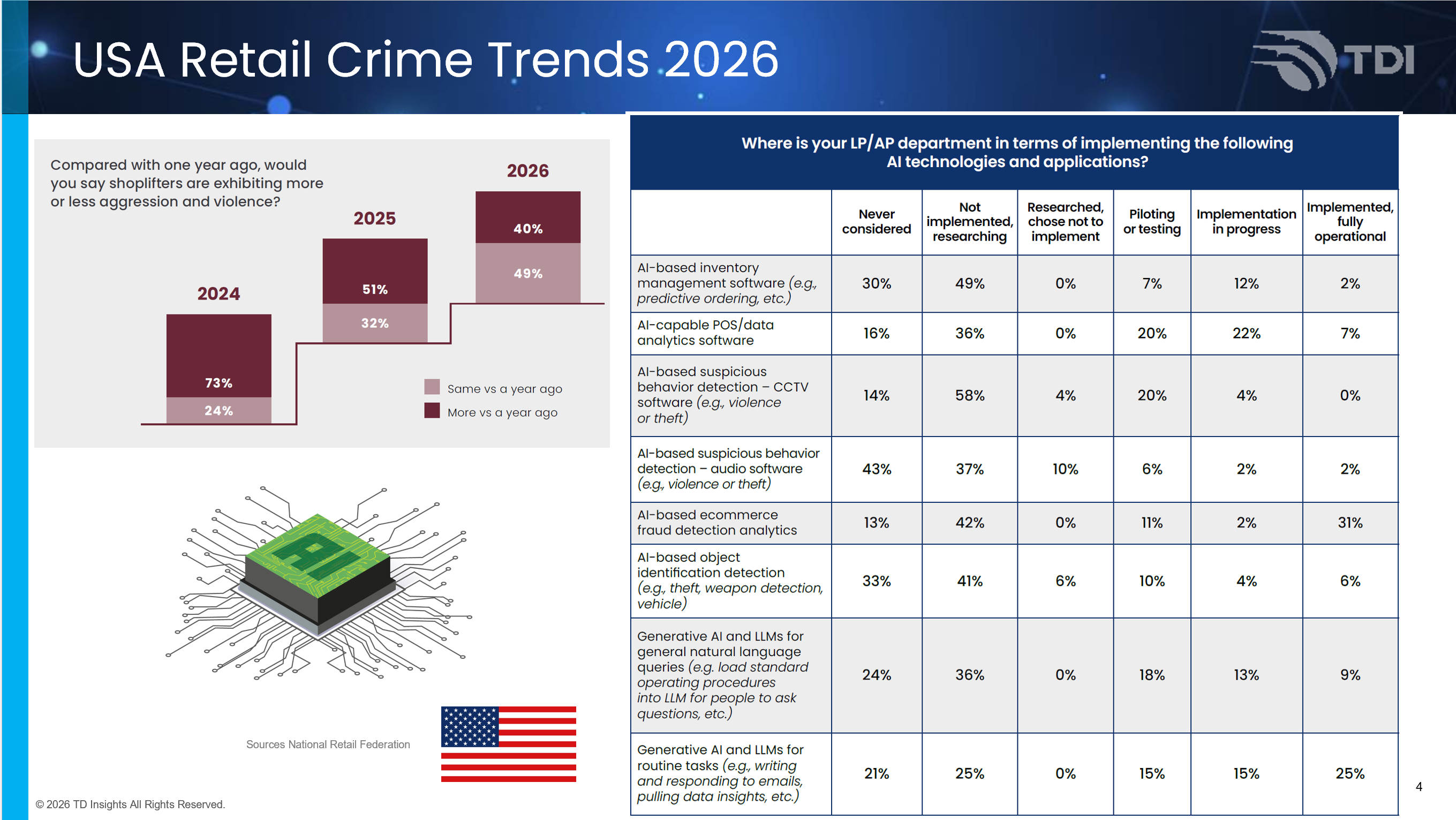
Chart: Loss Prevention / Asset Protection AI Priorities
The retail AI story of 2026 is a governance story wearing a technology costume. The winners are separating on data foundations, on measurement discipline, and on how deeply their own leadership teams understand what they are buying. Boards that ask about model capability are asking the second question. The first one is whether the data underneath is worth acting on.
Happy AI building everyone, and here is to a smarter retail year ahead.