
Explore how AI, evolving consumer habits, and new revenue models are reshaping retail
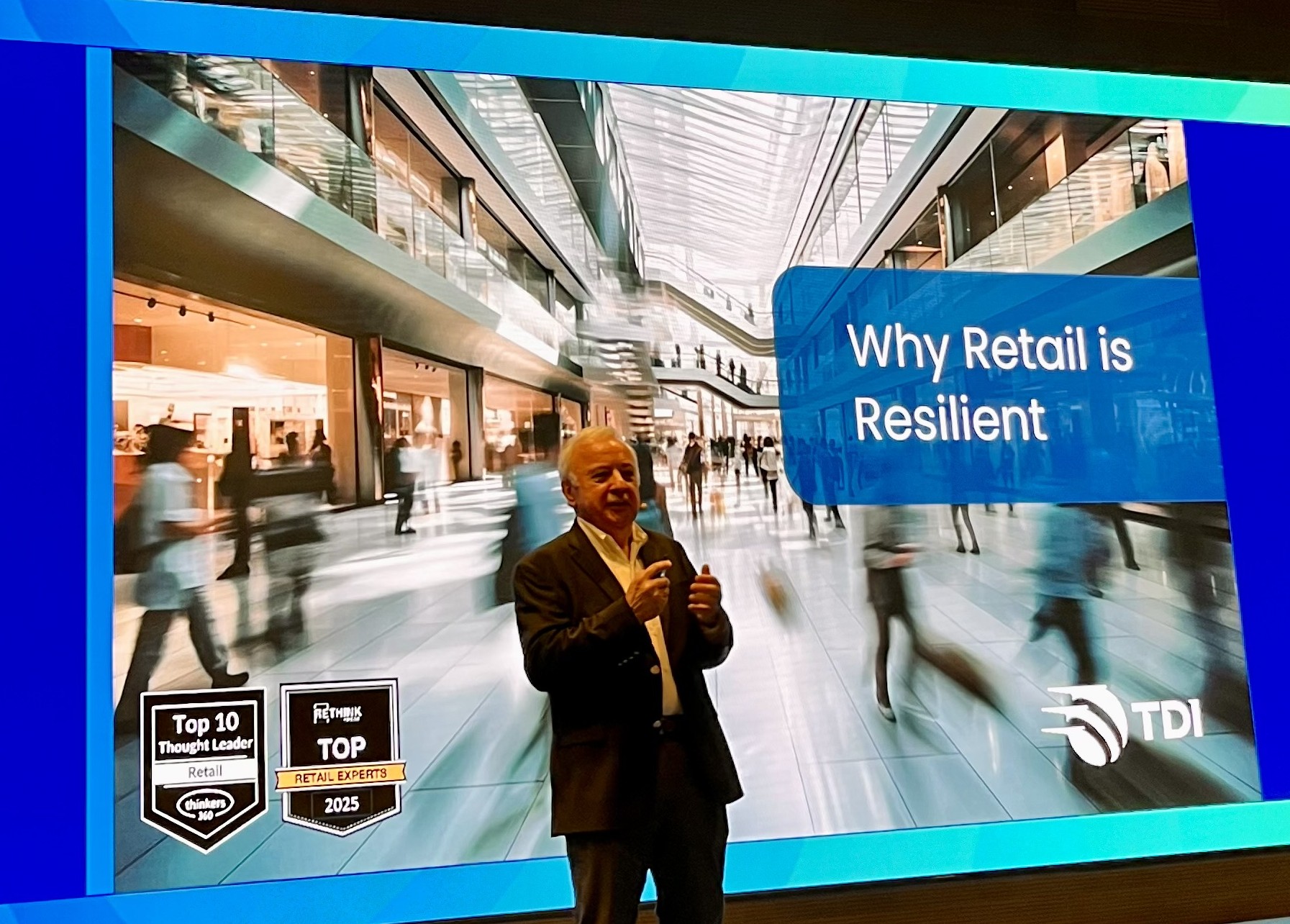
For the retail industry 2025 was another year of transformation, resilience, and recalibration. Tariffs, inflation, and continuing geopolitical tensions posed challenges, but demand remained strong in many regions, particularly in categories tied to lifestyle, wellness, and convenience.
Technology continued to reshape the retail landscape with AI tools driving greater personalization, automation, and smarter inventory management. Omnichannel strategies became standard, as shoppers increasingly moved fluidly between online and in-store experiences. Social commerce, mobile-first engagement, and retail media networks redefined how brands interact with consumers.
Overall, 2025 was another pivotal year where innovation and adaptability determined success. Retailers that embraced agility, data-driven decision making, and customer-centric models weathered the headwinds and laid the groundwork for continued growth into the new year.
The industry is not facing an apocalypse. Stores are not dead. Quite the opposite, the physical store has become an even more important component to the industry success formula. With all the hype of online taking over, it is worth remembering that 87% of all retail revenues in 2025 still had a store component.
If not an apocalypse, then what revolutionary trends are ahead for 2026? Artificial Intelligence (AI) will continue its march in disrupting the industry. A generational divide is accelerating how consumers engage across retail channels. Retailers are also finding and quickly adopting more unconventional revenue sources.
The Reality Versus the Hype of Retail Artificial Intelligence
By 2029, the IHL Group forecasts that AI will provide up to a $9.2 trillion economic impact on the retail and hospitality industries. Eighty-five percent of retailers agree AI advancements are transforming retail.
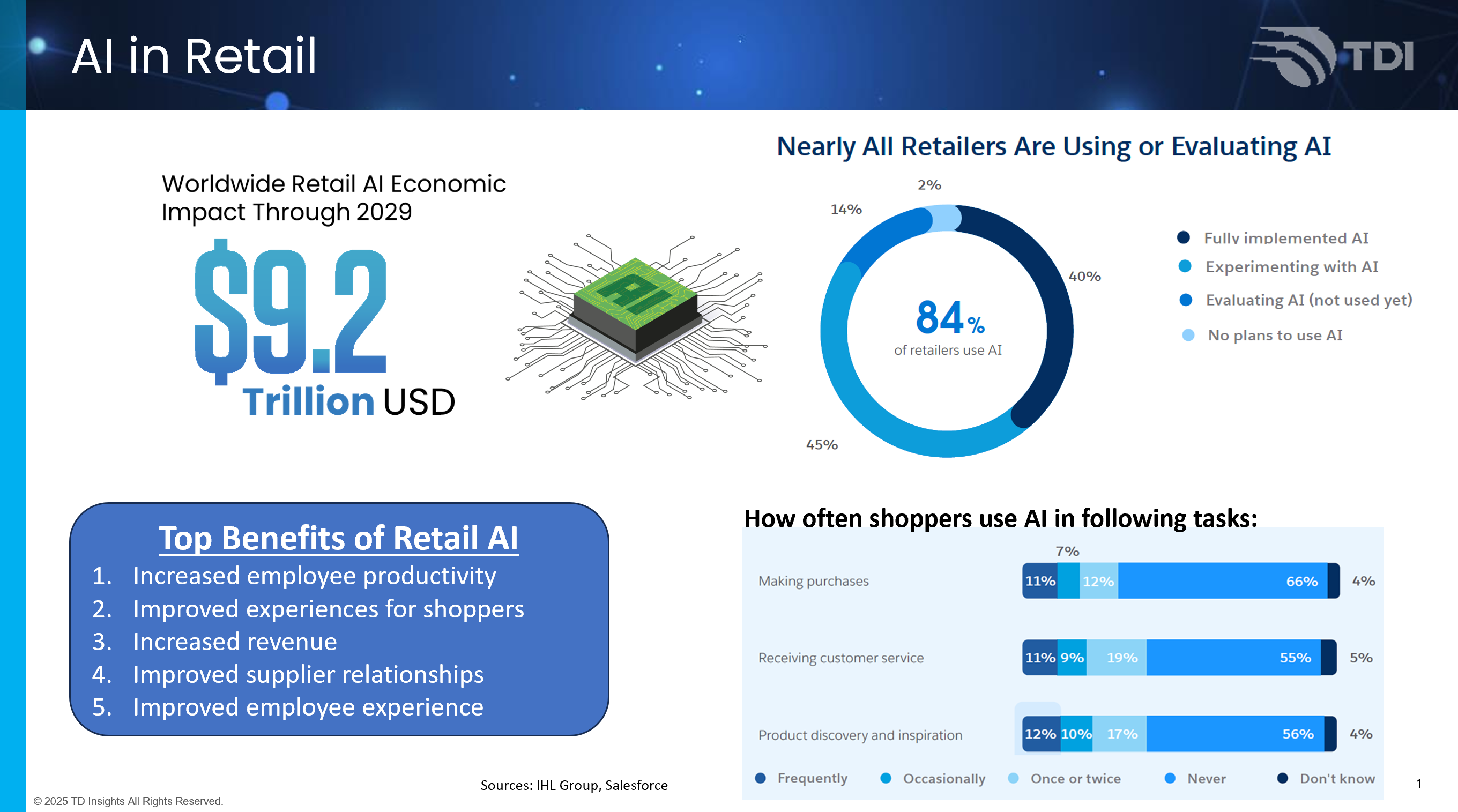
Already, 84%f of retailers are using AI and only 2% have no plans for it. "Most retailers intend to increase their AI investments, with 74% simultaneously boosting their data management investment — reflecting how accessible, integrated data underpins successful AI implementation."
Note in the above chart that consumers are not being shy in testing AI. On a spectrum from trying it once or twice to frequently, 30% of shoppers have used AI. For receiving customer service that percentage spread jumps to a total of 39% and for product discovery and inspiration, again it is 39% in total.
Agentic AI, which is the ability to take action autonomously without human involvement, is the latest innovation variant. Forty-three percent of retailers are piloting autonomous AI with customer service getting the most attention from fielding inquiries, managing returns, and other tasks. Agentic AI can also optimize websites, marketing materials, and even support store operations with associate training and managing inventory levels.
Retail AI investments are projected to surpass $100 billion by 2030. Note the 'game changers' areas in the upper right quadrant in below chart.
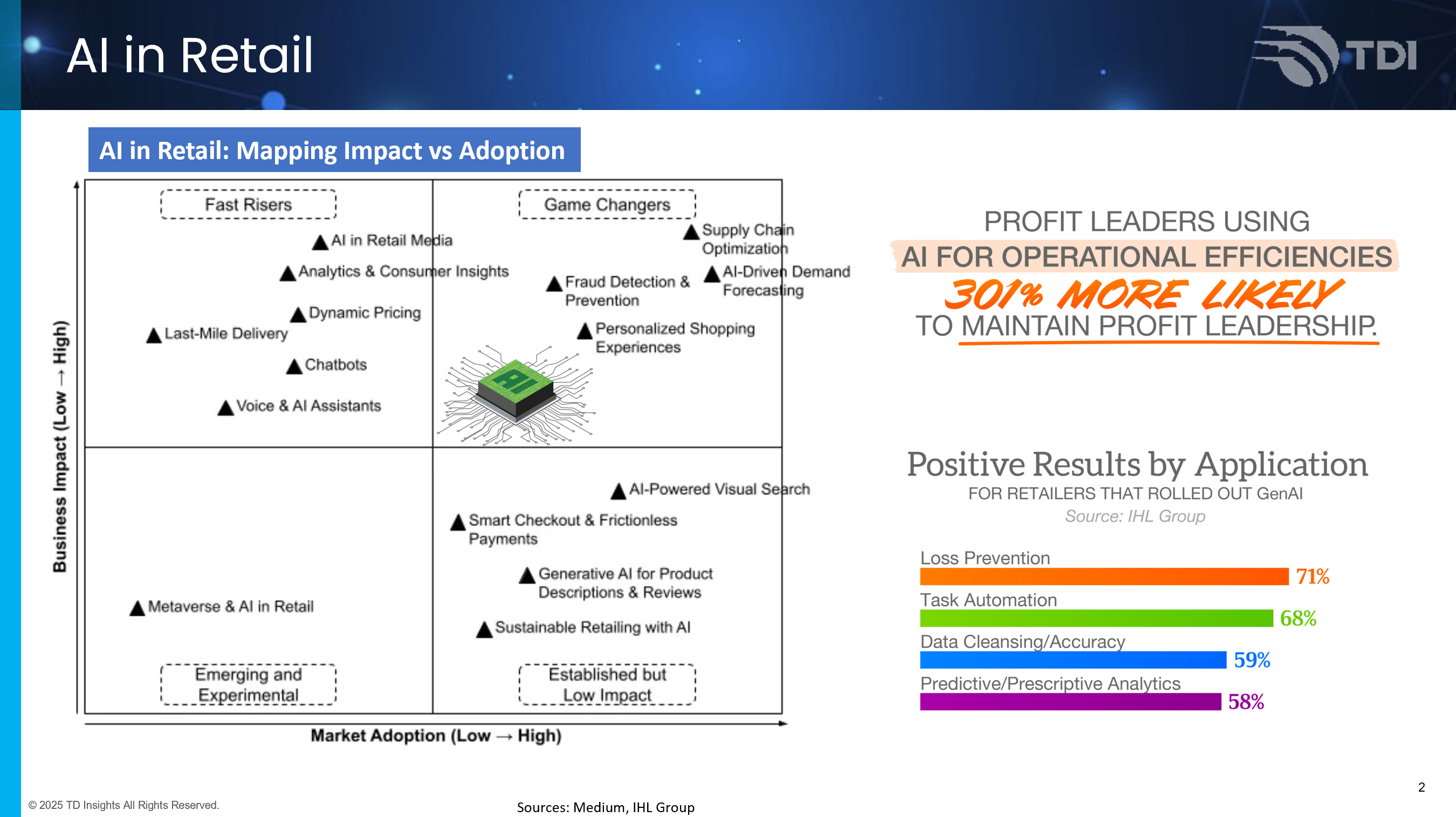
Profit leaders, which are defined as those growing 10%+ the previous year, are 301% more likely to maintain that profit leadership when using AI to drive operational efficiencies. From loss prevention to analytics, all retail functions are being impacted by artificial intelligence.
The Widening Retail Generational Divide
Back in 2018, Ad Age wrote, "Millennials have been accused of killing so many products and industries—taxis, landlines, snail mail—that it's become a media trope. But millennials are old news. Today, businesses and marketers are desperately anticipating the murderous whims of Gen Z, the demographic born after 1996."
GenZ and Millennials are not killing industries, but they are transforming them. This includes the retail industry.
Younger generations are adopting AI for shopping faster. Twenty percent of GenZ and 18% of Millennials are already using AI in their shopping journeys.
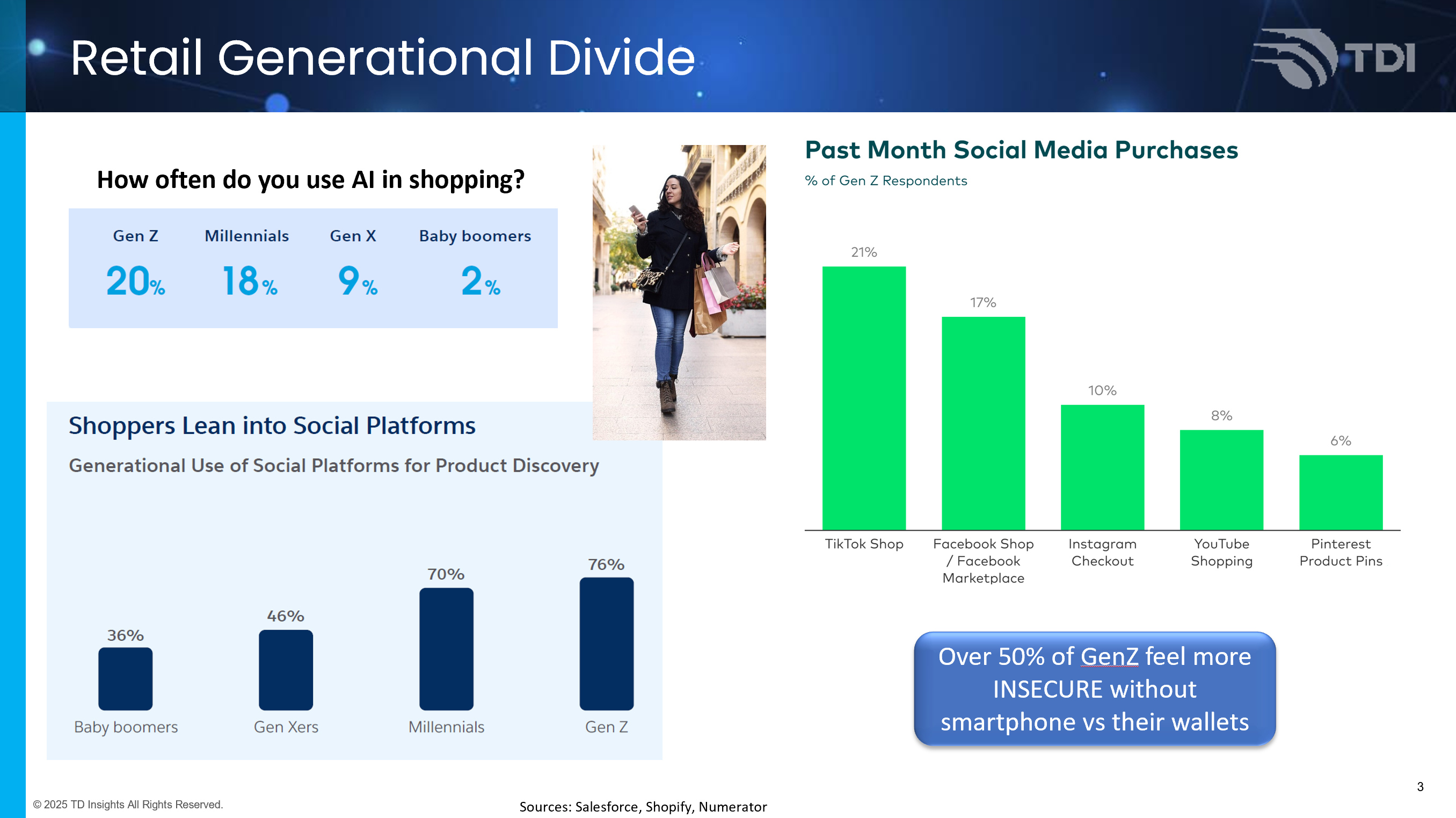
Younger generations are leading the charge in adoption of social media for shopping with both Millennials and Millennials above 70%. For GenZ, 44% are making purchases across platforms with Tik Tok (21%) and Facebook (17%) being the favorites.
Younger generations lead the way across every mobile shopping behavior. GenZ shoppers are twice as likely as baby boomers to use store apps for checkout, and eight times more likely to order from competing retailers while in store.
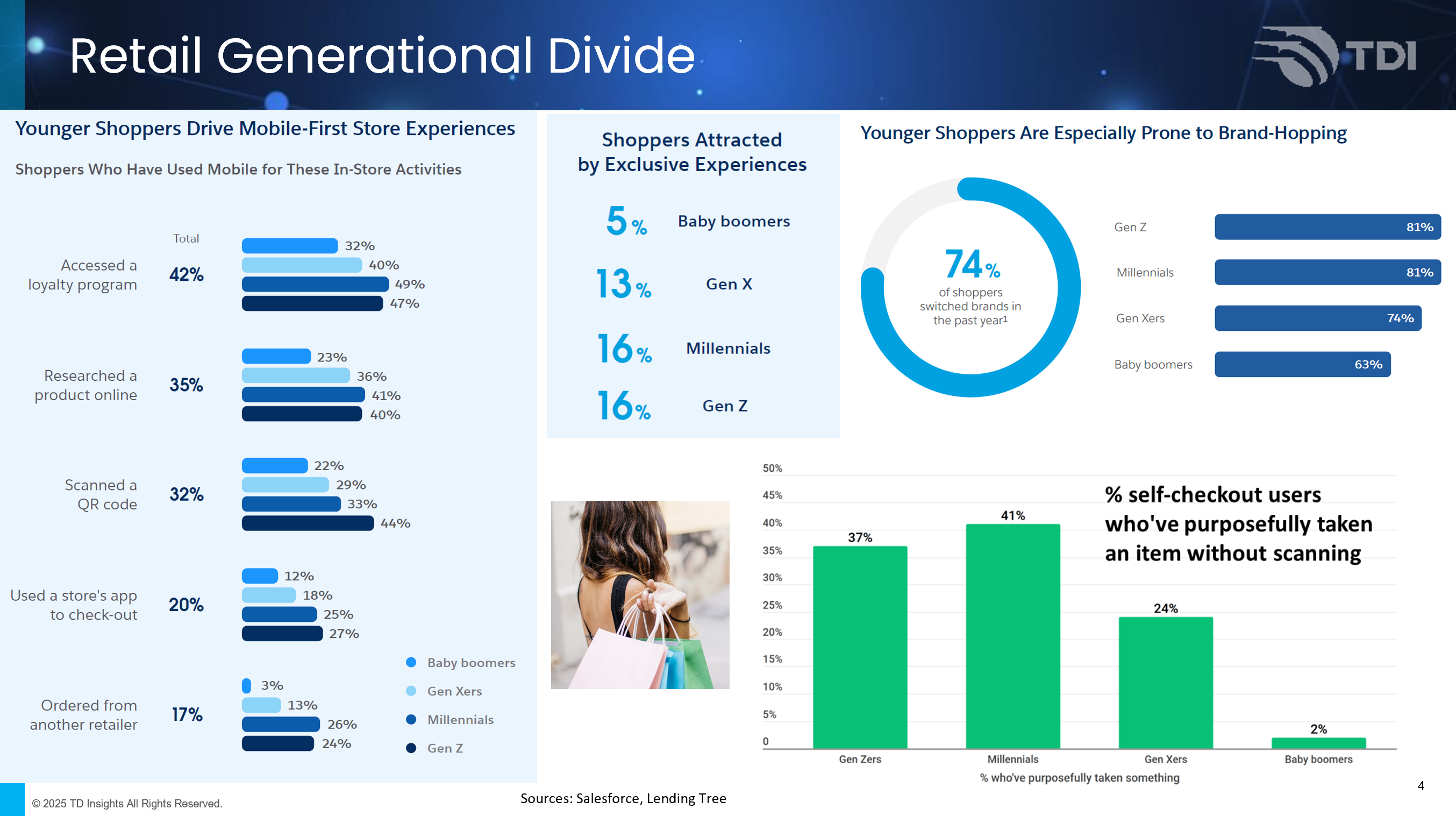
Younger generations want more exclusive experiences when they shop. They are becoming less loyal to brands. My favorite statistic above is that younger generations have the highest percentage of purposefully taking an item at self-checkout without paying for it. Forty-one percent of Millennials and 37% of GenZs admit to this type of theft, a wide separation, especially from baby boomers.
The Growing Supplemental Retail Revenue Streams
Retail used to be a simple business. As an industry, it has been around for millennia, from open markets to eventually physical stores that became larger and more complex. Online shopping brought a new dimension to the mix which Amazon mastered into a $638 billion monster company in 2024.
Amazon started out as an online book store, but has evolved into a highly diversified set of businesses driving supplemental revenue. In 2024, only 39% of Amazon's revenue was generated from their online retail store. Twenty-five percent was derived from third-party seller services. AWS, its cloud services division originally set up to run the business, was the third-highest revenue stream. AWS also produces more than half of the company's operating income at healthy margins.
Amazon is the poster child for supplemental revenue diversification. All retailers are now following and in some cases leading the expansion of revenue generating categories.

Paid loyalty programs is number one and Costco has mastered it. In fiscal 2025, Costco membership fees generated $5.3 billion in revenue.
Retail media networks are next on the potential expansion of supplemental revenue and they are just getting started. The master again is Amazon which generates $56 billion in revenue from advertising services.
As the rest of above chart points out, retail media networks are just getting started. By 2028, in the USA alone, retail media networks spending will reach nearly $100 billion.
The next logical frontier for retail media network is the physical store. Note the much larger audience available to monetize advertising inside stores below.
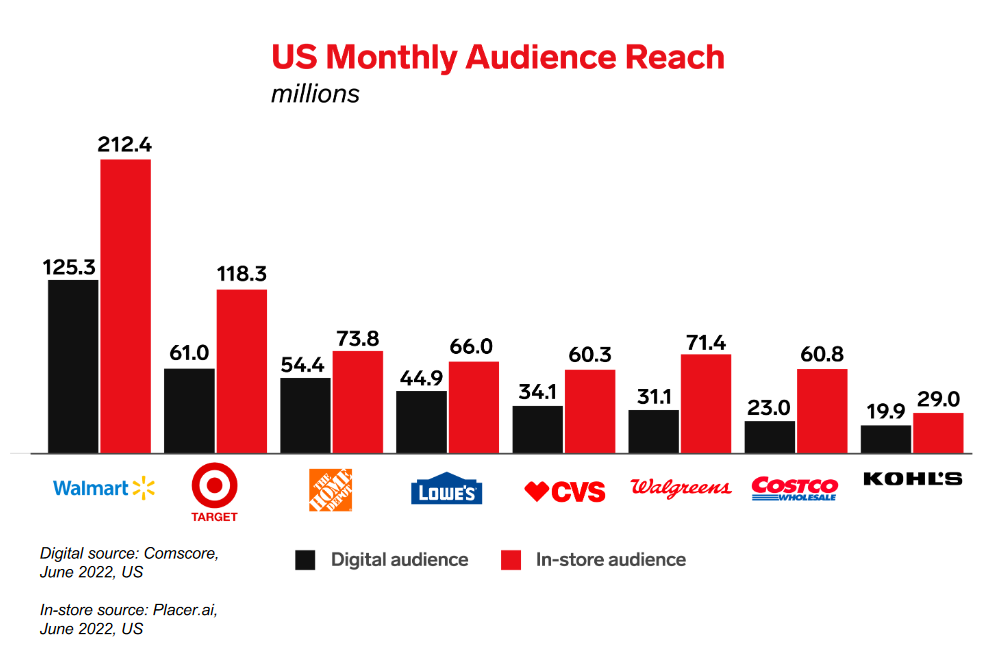
Fifty-three percent of consumers want personalized in-store ads via a display in a smart shopping cart, smart mirrors, or interactive touchscreens. "In-store ads have a significant impact: 32% discover new products this way. Over half (58%) of consumers want to see ads that cater to their non-retail needs, such as insurance, travel, and healthcare."
2026 will be another year of retail transformation. AI and younger generations are driving an innovation revolution. The new technologies will open the industry to new growth possibilities. The definition of what is retail will continue to change and the number of revenue sources will be limited by brands' imagination. Exceptional immersive customer service and branding focus will remain the benchmarks for a successful industry future.